Category Archives: read

Life

It’s been a while. A year or more, I think. I’ve started a few posts – on topics as varying as what I’ve cooked lately, how I’m feeling about loss, the podcasts that most interest me, and the wonders of watching your baby in their first incredible year of existence. Nothing felt quite right for publishing, though the readership of these words is primarily a small group of family and friends.

Perhaps the issue is simply this: there’s too much to say. Too much to write. Too much on my mind. My father passed away last spring, and the loss is one that is hard to put into words. My baby was born 14 months ago, and the miracle of her life is perhaps equally difficult to articulate. I recently started writing down, once a day, the meals I’ve eaten and the moments I’ve appreciated, just to get some thoughts on paper. It’s as though my creative gears had frozen up a little, and having a reason to write something, small and insignificant, loosened things up slightly. The days are longer, too. And the magnolia we planted in our front yard last year is in bud. There’s much to celebrate.
LND_1FDD281B-F3E5-4D22-9BDE-61FF39E5919F

Here are a few things worth sharing:

This particular episode of the Better Off podcast, a surprisingly relatable personal finance resource that I generally enjoy and find to be informative. In this case, a young man calls in looking for an opinion about his potential plan to buy his recently deceased grandmother’s house from his mother, so that his brother can continue to live there. While he hikes the Pacific Crest Trail. As his story gets increasingly complicated, the host, Jill Schlesinger, simply says, “You know why I don’t like this idea? Because it doesn’t solve anyone’s problems.” Or something to that effect. It made me laugh out loud, because sometimes a person facing a decision just needs an honest assessment of their situation.

This amazing essay about modern arctic exploration. Apparently, the author, David Grann, has quite a cult following – and now I can see why. If you can cobble together two hours or so for a truly outstanding read about courage and obsession and family and history, regardless of your previous interest (or lack thereof) in icy adventures, make a point of reading this article in The New Yorker. I’m sure the print edition from February 12 & 19 is floating around in the world, but if you don’t have a copy handy, the online version is visually pleasing, with lots of well placed photos and maps.

This intriguing and accessible book about the history of flavors in American cooking. From the surprisingly exotic origins of black pepper to the enterprising immigrant tale of Sriracha, there’s much to consider from chapter to chapter. I wasn’t really in the mood for a crime solving plot or a romantic entanglement of any kind, and this was a nice way to enjoy a book without becoming emotionally engaged with a novel.

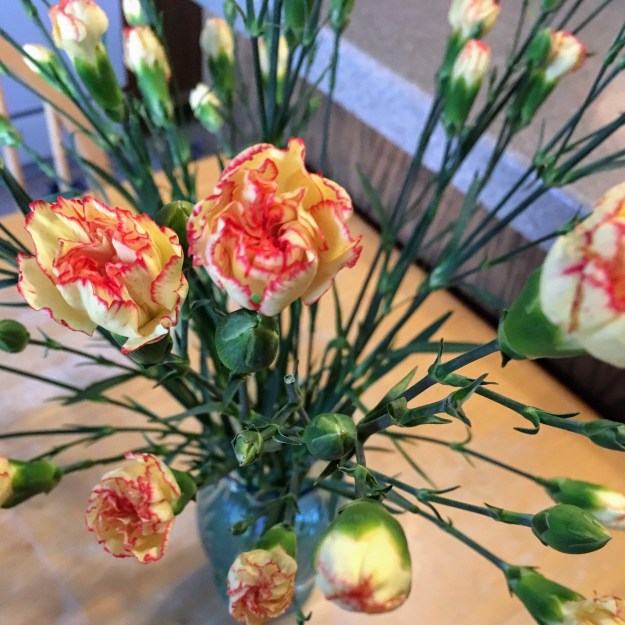
And finally, a single inexpensive handful of carnations from Trader Joe’s (see above), because a delightful photo essay in Better Homes & Gardens a few years ago alerted me to the simple beauty in loosely bundling a few dollars worth of carnations (which is a surprising lot of flowers) in a rubber band towards the base of the stems, and sliding them into a vase. The miniature ones edged in a contrasting shade are ideal, and are currently brightening our kitchen.

Photo credit: mine.
January Thoughts

Well, it’s been a while since I’ve had something to say on here. When I started this project, I had a plan – a schedule and a list of topics and ideas and concepts. It turns out that actually, I started this blog because I enjoy writing. And consequently, my motivation to write comes in waves, generally inspired by something in my life.

As it happens, I had a baby one month ago today. That inspired me to write, certainly, but not here, for the world to see (isn’t it odd that the internet really works that way?). We’re all doing well, if a little short on sleep, and her presence has forced me to slow down a little. I’ve been standing at a distance from much of the news and commentary that’s circulating, intentionally creating some space to read, and to think.

I recently finished The Optimist’s Daughter, by Eudora Welty, which won the Pulitzer Prize for Fiction in 1972. It’s a tale of family and loss and reflection, and a quote from the final passage has stayed with me. “The past is… impervious, and can never be awakened. It is memory that is the somnambulist.” The loss, in this example, is viewed simply as an event that occurred. Any pain or regret that exists is tied to the memories of that loss, which we manage as best we can. This idea that the past happens and stays put, while our memories chase us, is intriguing, and perhaps empowering.

Though I hope to tackle another book soon, essays and articles are more my speed, these days. I’ve been making my way through recent editions of The New York Times Magazine, and I can confidently recommend the following selections.

Neanderthals Were People, Too New research shows they shared many behaviors that we long believed to be uniquely human. Why did science get them so wrong? (by Jon Mooallem, January 11, 2017)

‘We Are Orphans Here’ Life and death in East Jerusalem’s Palestinian refugee camp. (by Rachel Kushner, December 1, 2016)

How to Hide $400 Million When a wealthy businessman set out to divorce his wife, their fortune vanished. The quest to find it would reveal the depths of an offshore financial system bigger than the U.S. economy. (by Nicholas Confessore, November 30, 2016)

As an aside: in referencing the list of Fiction Pulitzer Prize winners for this post, it seems equally (or better!) aligned with my reading interests than does the Booker Prize list, which I wrote about previously. If you’re looking for a reading recommendation, that may be a good place to start!

Booker Prize

I had a plan, a decade or so ago, to carry around the Booker Prize lists with me and steadily make my way through the winning selections as I made choices at the library or asked for books as gifts. As it happens, the plan didn’t stick and the list (which I had carefully formatted, printed, and folded up in my wallet) got misplaced.

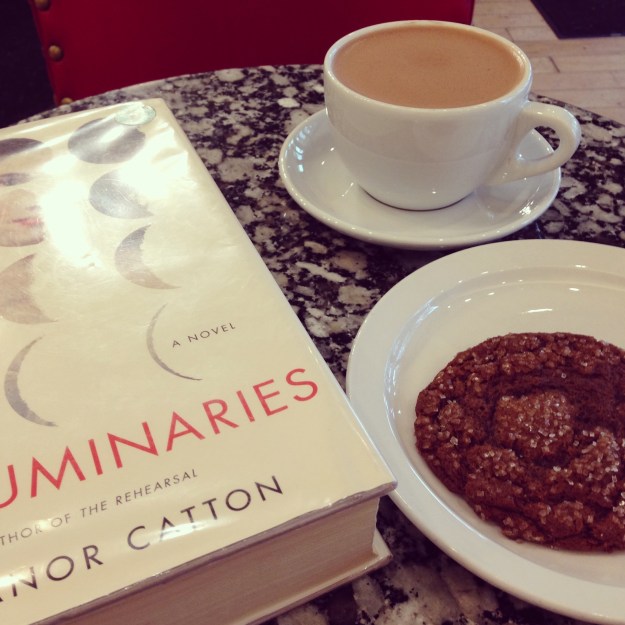
I should have stuck with the plan. This morning I finished Eleanor Catton’s extraordinary novel, The Luminaries, winner of the 2013 Man Booker Prize. It was the very best book I have read in a long time, and probably towards the top of any “favorites” list I might create. Simply put, it is clear to me that Eleanor Catton is a genius. How she imagined such a twisty tale of various perspectives is one thing – how she managed to put it all together in such a surprising and intriguing manner is quite another. Whatever you might expect of a plot set in the gold rush era of New Zealand, about 150 years ago, you’d probably be quite underestimating this tale. You might also be surprised to hear that Ms. Catton, aforementioned genius, was born in 1985 – she is the youngest author ever to win the Booker. In other literature award record breaking news, The Luminaries is the longest book ever to win the Booker. At 832 pages, this is a book that takes a bit of dedication.

img_4198

Though I haven’t exactly made my way through the lists, I see that a few of my favorites either won or were shortlisted. Notably, Simon Mawer’s The Glass Room (shortlisted in 2009), Zadie Smith’s On Beauty (shortlisted in 2005), David Mitchell’s Cloud Atlas (shortlisted in 2004), Zoe Heller’s Notes on a Scandal (shortlisted in 2003), Margaret Atwood’s The Blind Assassin (winner in 2000), Arundhati Roy’s The God of Small Things (winner in 1997), and Rohinton Mistry’s A Fine Balance (shortlisted in 1996), are all books that I would heartily recommend.

The 2017 lists won’t be released until next summer, so we all have a bit of time to work through the backlog of winners and shortlisted selections. Happy reading!

Reading.

As I collect my notes about spring flowers (daffodils are abloom!) and plan a proper post, here is another installment regarding my latest adventures in reading.

Forty Rooms, by Olga Grushin

I wasn’t so sure about this book when I got started, but that happens sometimes. However, as the dreams and tales of the main character took shape, I realized how charming the approach was, to weave a life across the forty rooms it exists in over time. Born and raised in Moscow, the narrator moves to America for college and her life unfolds from there. Though much of the story takes place in the East Coast suburbs, there is something quite Russian about the novel and its layers of love and despair.

Case Histories, by Kate Atkinson

I love me some Kate Atkinson, and this is the first in her mystery series. I stumbled upon this wonderful book a few years ago, and then lost track of the author. When Life After Life became so famous, I sorted out that this was the same genius I had accidentally discovered earlier, and now I am very slowly permitting myself to read her books as a treat (though it appears that when I run out I can watch her show!). Her characters are complicated and interesting, and she delivers a twisty topsy mystery with a clever literary touch.

It’s What I Do: A Photographer’s Life of Love and War, by Lynsey Addario

It seems that the world is a beautiful and often troubled place, with more similarities between people than differences. The life that Lynsey Addario has chosen, photographing communities and conflicts in distant corners of the world, is courageous and eye-opening. Creating relationships in the most unlikely of places, she has followed her heart and her instincts and her photojournalism assignments to the most dangerous places at the most dangerous times. This is an astounding tale with a message that settled deep within me.

Eleanor & Park, by Rainbow Rowell

If you were ever a teenager, you can probably connect with this story. From my advanced age of 33, it seems like a much too complex and violent and sexual tale for actual teenagers to read, but apparently that is the intended audience. Much can be said that is trite or foolish about those years when life and love seem so impossible, but this author wrote a surprisingly lovely story about some truly real and troubled teenagers, and I couldn’t recommend it more. Here’s a proper review of it that is lovely in its own right.

Salt to the Sea, by Ruta Sepetys

This is a beautiful and thought provoking piece of historical fiction. It’s 1945 and thousands of people are headed west from Latvia, Lithuania, East Prussia, and Poland, fleeing the advancing Russian forces who are gaining a reputation for violence towards civilians. Unfortunately, unless you carried the correct identification papers, arriving in German territory brought its own complications. The story moves quickly, as the narration shifts easily between four individuals with their own unique perspectives.

Ready Player One, by Ernest Cline

The future looks grim in this dystopian tale about a society that prefers to log into a world of virtual reality than face the despair around them. It’s at once a warning bell to remind us that the real world is where life happens, and a nostalgic look back at the video games and music of the 1980s. We’re following a young man who is tackling the biggest challenge yet presented in their virtual world, a sort of online riddle with real life consequences. Even though I don’t possess a deep catalog of gaming memories, I really enjoyed this cleverly imagined novel.

Simply Recipes

There is a blog, called Simply Recipes, that is reliable in every way. It is appropriately named, it is well maintained, and every recipe I have tried has met my every expectation. The clever woman behind the effort is Elise Bauer, and I like to think that if we lived near each other, we would be friends. It seems she was one of the first people who blogged about recipes, which must be how she got such a straightforward name for her website. She takes all the pictures, tries all the recipes before sharing them (or creates them herself), provides clear direction and suggestions, and posts regularly. Her recipes are organized by season and by ingredient and by category, and easily searched.

I have made a lot of her recipes, and with great success. I also find that if I’m stumped about what to make, browsing around on her website is a quick way to get inspired or to chase down a good idea for a particular ingredient. Here are some of my favorites, directly linked in the hope that you will explore her whole website yourself. Enjoy!

Chicken Piccata – an easy way to make chicken seem fancy.

Cajun Chicken Salad – one of my favorite things to have on hand for lunch!

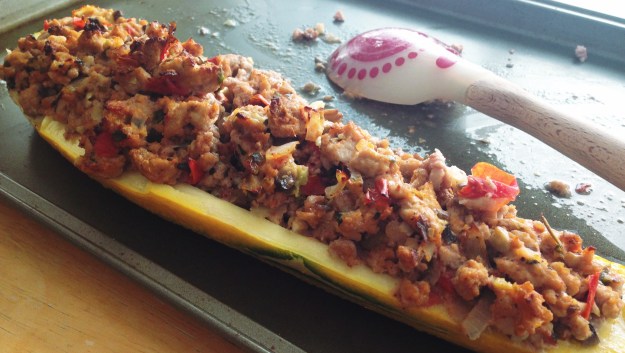
Stuffed Zucchini with Turkey Sausage – a huge hit last summer, and a great way to manage more than one monster zucchini!

IMG_2682

Yes, this enormous vegetable did grow in our garden.

Grilled Skirt Steak Skewers – hands down the best grilled meat that I have assisted in preparing.

Hamburger and Macaroni – basic, cozy, delicious.

Franks and Sauerkraut Paprikash – hotdogs and sauerkraut and sour cream! Hurrah!

Poached Salmon – just as promised.

Easy Coconut Shrimp Curry – versatile and quick!

Spring Minestrone Soup – each spring, I look forward to making this flavorful soup.

Pickled Beets – a nice side dish, or addition to salads.

Zucchini Bread – reason enough to grow zucchini again this summer.

Traveling

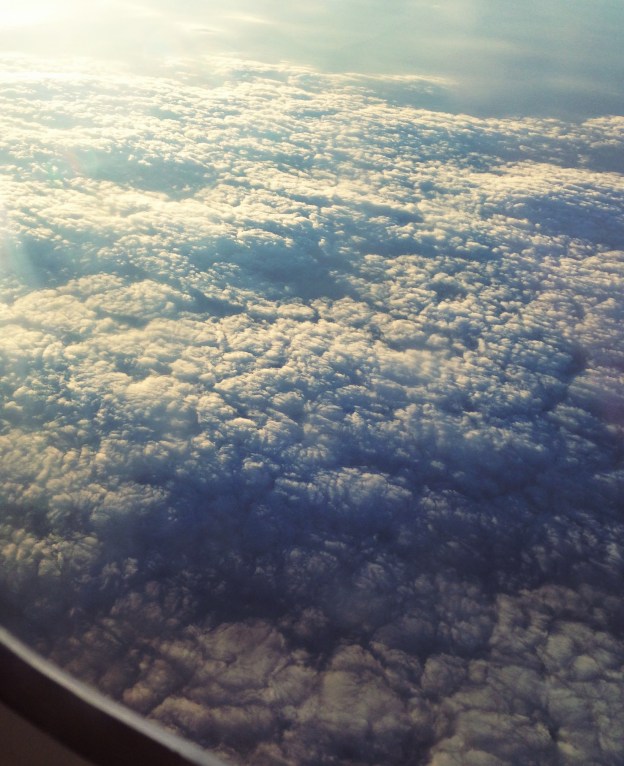
I’ve been on the road a lot lately, for work and non-work reasons. Last month, I went to Carmel, Indiana and to San Antonio, Texas. This month, I’ve been to Maine (with stops in Portland, Weld, Augusta, Bath, and Freeport) and to San Diego, California. I’ve seen family members, coworkers, and lots of airports.

It can be difficult to keep up with email and news headlines (and blog posts) while traveling, but there’s one resource that I manage to check regularly, even when my routines are disrupted: The Skimm. The clever and intelligent women behind this concept figured out that if you keep to the facts and insert some humor, a daily email that contains news headlines and a bit of editorial might really be appreciated. I initially heard about this fantastic concept in Fast Company, in a section where innovative people are asked to share a tip about something that’s intrigued them lately. That was two years ago, and I have been an informed and amused follower of their efforts ever since. More than a million people now receive the email, which opens with a quote of the day. Here was today’s:

QUOTE OF THE DAY
“As a nation we are not getting enough sleep” – A new study, drawing the groundbreaking conclusion that at least a third of Americans are tired. Thanks for that.

The topics are broken out into conversational headlines, summarized neatly, and loaded with references. Their recent write up of the New Hampshire primaries linked directly to 13 sources, including the NBC News, the Washington Post, CNN, CBS-Boston, Reuters, and the New Hampshire Union Leader. They offer further information on particular topics in “Skimm Guides” on their website, ranging from Super Bowl 50 to The UN General Assembly. They also provide thorough and balanced election information, including their own interviews with many of the candidates, introduced with: “Heads up, you have to hire a new president.”

If you visit their website, a pop-up asks if you’d like to sign up for the email. Your other option is: “No thanks, I prefer to be miserable in the morning,” which gives you a sense of how they’re taking on the world. Both founders have journalism backgrounds, and they have been thorough and capable and hilarious from their earliest efforts, with an eye towards building a community of followers. That has worked so effectively that even though Oprah has recommended them, I still feel like I’m getting an email from some very above-average friends every morning (scheduled for my time zone, incidentally, with an option to specify my preferred arrival time).

Photo credit: mine!

Reading.

As promised, I’ll write regular installments about the books I’m reading. I introduced the idea here, and will continue the effort over time.

The Tin Horse, by Janet Steinberg

I’ve read a lot of books (textbooks, even) from the European Jewish perspective during WWII, but this may be the first story I’ve read from an American Jewish perspective from that time. This was a tale of teenage life and love, complicated by immigrant parents and cultural expectations. It isn’t the most well written book in the world – there were too many adjectives, I think – but the characters were strong and the plot was engaging.

IMG_3384

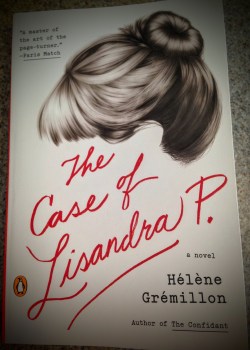
The Case of Lisandra P., by Helene Gremillon

A French teenager once told me that he can always tell when a movie in France was dubbed and when it was actually French, because American movies always end happily, even in the most unlikely of circumstances. This book is translated from the French, and squarely proves his point. Even relative to other plots that seek to determine how or why the main character was killed, this does not end happily. It is well written, presumably well translated, and reading it feels like an artistic experience of sorts, but boy is it depressing.

A Window Opens, by Elisabeth Egan

I was bothered by this author’s frequent references to hipsters and e-readers and brand names of all sorts (and her unforgivable decision to employ the word “momversation”). I’m also resistant to incorporating text message and email language into the story, but all of that aside, this was a quick read. A family in New Jersey is facing career shifts, marital challenges, and aging parents. The “working in Manhattan and bemoaning recent changes to the city” commentary and specificity of the whole tale will feel wildly outdated in about 18 months, but the heartbreakingly insightful passages related to family dynamics and career exploration held my attention.

Atlas Obscura

There’s a website called Atlas Obscura. The people behind this fascinating spot on the internet collect images and tales of the most strange and wondrous places and happenings in the world. They distribute a newsletter packed with captivating stories, and they even host intriguing events like this lock-picking party in New York.

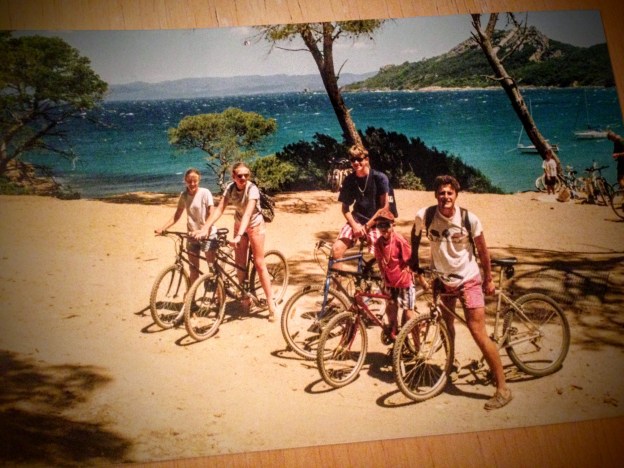
When I first discovered Atlas Obscura, one particular memory came crashing forward. At 15, I was very fortunate to spend a month in France. I was studying French in high school, my family was comfortable with me traveling alone, and I had relatives (the sister-in-law of my uncle’s brother-in-law, to be exact) willing to host me. We ate fresh tomatoes and apricots unlike anything I’ve tasted before or since, we sailed on the Mediterranean, and we rented bicycles to tour Porquerolles (as seen above). I have misplaced the journal that I kept during that grand adventure, but what sticks in my head as the most appropriate Atlas Obscura point of interest begins with a clear memory of a hot and sticky July afternoon in the town of my hosting family’s grandparents. We wandered down into the village to an enormous old structure that was one part sculpture and two parts crazy, sitting dustily on the side of the road. The rural area was dominated by orchards and rolling hills, and the walk home was unpleasantly steep, but this bizarre creation was not a sightseeing opportunity to be missed, and I was an out of town guest.

Sitting at a computer 18 years later, and struck with the sudden need to identify this place and flag it in my Atlas Obscura profile, I took to the internet in a passionate searching quest. However, not knowing the name of the town or the spectacle, and unsure if any English speaking source would make note of it, I was at a loss.

Family being what it is, I spent a weekend last summer with the son of the aforementioned brother-in-law of my uncle, and I asked him if he could help. He was a toddler when I visited France, but that odd place in my memory is still a real location in his grandparent’s village. He laughed and said, “Ah, the Idiot’s Palace! Yes, it is famous now, and they actually charge an entrance fee!” He looked it up on the internet right there on the lawn and sent me the link.

I am pleased to report that Postman Cheval’s Ideal Palace is listed on Atlas Obscura, and I have now flagged it as “been here!” in my profile.

Books

I like to read, and usually I prefer to start a book without knowing much about what to expect. The trouble with that approach is that it can be hard to know which books to choose. And so, here are a few books I have read lately, with perhaps enough detail for you to decide if you might be interested.

***

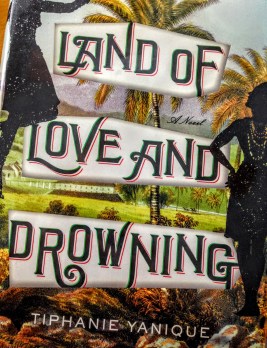
IMG_3298Land of Love and Drowning, by Tiphanie Yanique

This unsettling story of heartbreak and hope is beautifully written. As much about St. Thomas and the surrounding Caribbean islands as it is about one family’s secrets and dreams, it offers an historical perspective on the unanticipated consequences of development and opportunity, at both a national and individual level. Most of all, this is a captivating tale of the twisted paths we follow to find (and survive) love.

Eileen, by Ottessa Moshfegh

This is the tale of a sad and lonely young woman who copes with her alcoholic father at home and the depressing atmosphere of a juvenile detention center at work. In her own surprising way, she discovers that she may not be as alone as she thinks, and eventually finds direction. It’s not an uplifting book, by any measure, but it is very well written and I appreciate a protagonist who isn’t always so easy to champion.

Let’s Pretend This Never Happened, by Jenny Lawson

If you want to laugh a lot and wince a little, and wonder at the variety of the human perspective, this is the book for you. Jenny Lawson blogged about her strange predicaments and her odd view of them until someone noticed how popular she was getting and published a whole book of her writing. This is my favorite section, but the book offers hundreds of pages of the same.