Category Archives: create

Lists

I haven’t written here for a while, not for lack of activity or thought, but rather because life is going in so many directions that I haven’t been particularly good about sitting still and thinking in a focused manner. And really, to effectively write something, sitting still and focusing is a good starting point.

I used to have a regular habit of journaling, nightly, and for periods of time it felt like a necessary element of sanity. I realized a few months ago that I had gotten out of the habit, so I bought a fresh new journal and placed it next to my bed. It turns out that I haven’t written in it much, and when I have, it reads like an oddly formal update about my life, as though the pages of my journal require me to keep current notes on the events unfolding. I dimly remember a time when I used that space to clear my head in the evenings, to explore my emotions and record them, so they could stop rattling around inside me. Maybe lately I don’t have such busy thoughts. Or, more likely, they are so busy that a journal isn’t the right tool to collect them.
IMG_4007

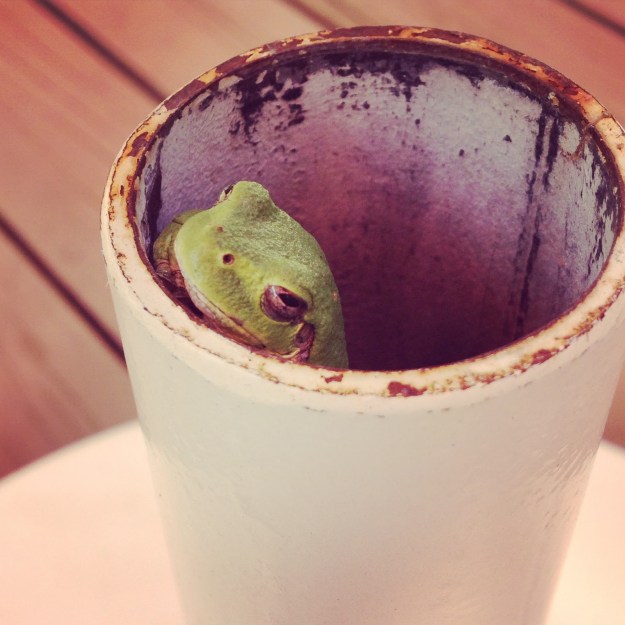
This little dude was relaxing in the umbrella stand all afternoon. Maybe he was thinking.

Which brings me to my point, really. I’m considering lists. Not in place of journaling, necessarily. But as a way to get my thoughts down on paper without trying so hard. Lists as an interim solution until my brain activity slows from a fast paced zipping about mode to a more reasonable speed where thoughts can more fully develop. I have one of those notebooks with the spirals at the top and pages divided into two columns, and I’m going to start making lists of all kinds. As a child, I had a very similar notebook. In those heady days of elementary school, I would label the columns with headings (often, “love” and “hate”) and then list names of classmates boldly down each side. I didn’t go back to revise them over time, but I had many fresh versions, and the names changed and shifted over time. Eventually I started creating a third column that was labeled “like” and most names migrated into that list. I found that notebook about 15 years ago, and perhaps there were other lists contained in those pages, but it is these definitive love/hate ones that I remember discovering.

For now, I’ll make less divisive lists. I have already started categories such as “plants to grow” or “favorite meals” or “things to do in the summer” or “places to visit” and it is going okay so far. I’ve discovered, however, that to ignore the column structure and write straight across the page is a challenge for me. My early listing instincts were to create comparisons, and it still feels appropriate to do so, or at least to use the left column for ideas and the right column for related notes. Perhaps, in the spirit of my younger self, I should really set up binaries such as “plants I love” and “plants I hate” or “places to visit” and “places to avoid” – neatly divided lists, side by side, to keep my thoughts nicely organized.
Spring Blooms

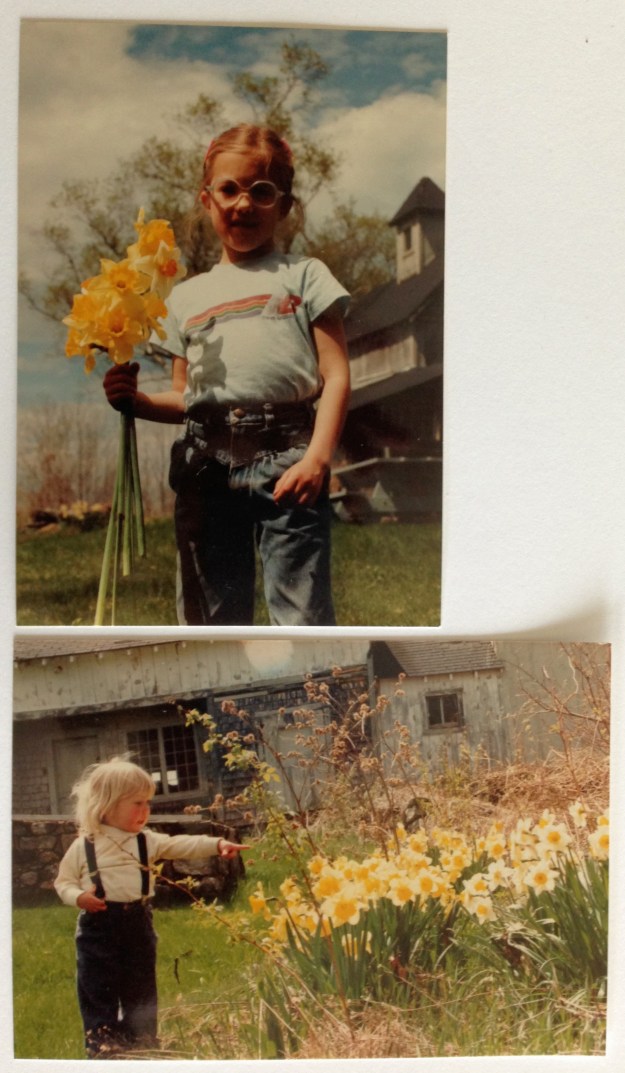
The sturdiest plants of my childhood grew from bulbs. Those reliable little balls of energy would poke leaves and stems up through the dirt every spring – daffodils, especially, multiplying each year to create enormous sprawls of color. We grew up surrounded by my grandfather’s well-established gardens, making bouquets and taking the splendor for granted. As I got a bit older I loved to dig up the bulbs on a fall afternoon, separate them to encourage growth, and reshape the drifts. I’m partial to single varieties, doubles being a bit too showy for my liking, and my favorite is the delicate Narcissus Actaea, known as the Original Poet’s Daffodil. Each slender stem produces a simple but elegant bloom that is startlingly white with a yellow trumpet edged in red.

IMG_3706

Me, holding daffodils. My sister, pointing at some. 1988.

This is our second spring in this house, and the landscaping choices of the previous owners relied heavily on expanses of black plastic covered in 2-inch rock. We’re gradually undoing that approach, and a great effort was made last summer to clear the area around a crabapple tree in our front yard and get down to dirt. In the fall, much later in the year than was practical, we ordered some bulbs from Holland (truly – the box was stamped by customs!). We dug three holes near the recently liberated trunk of the crabapple tree and applied a layering approach that I found on the internet. The concept, which would also work in a container, was to build a sort of lasagna of bulbs and soil and compost, allowing for various types of flowers to exist in one little plot. Daffodils went in first, then the soil and compost, the tulips, more soil and compost, and then the crocus bulbs (and more soil). I planted the remaining daffodils and tulips in the backyard, my frozen fingers reminding me that the third week of November was a bit late for such a project. The chill in the air and the soil made me wonder if any spring blooms would even emerge.

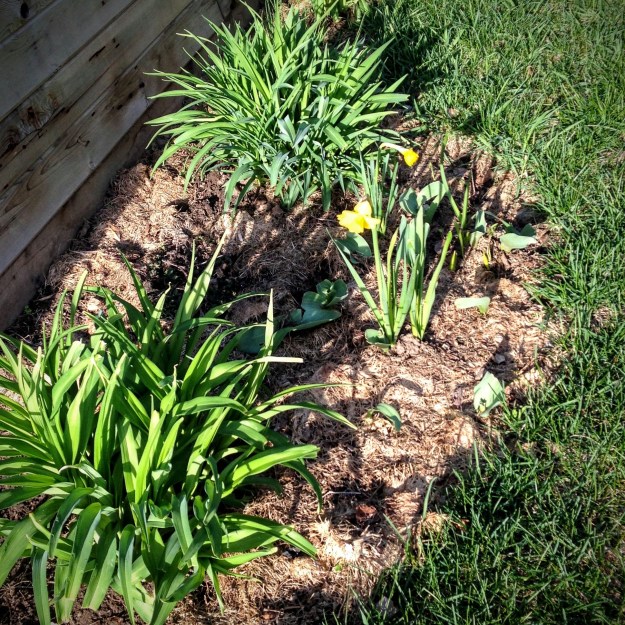
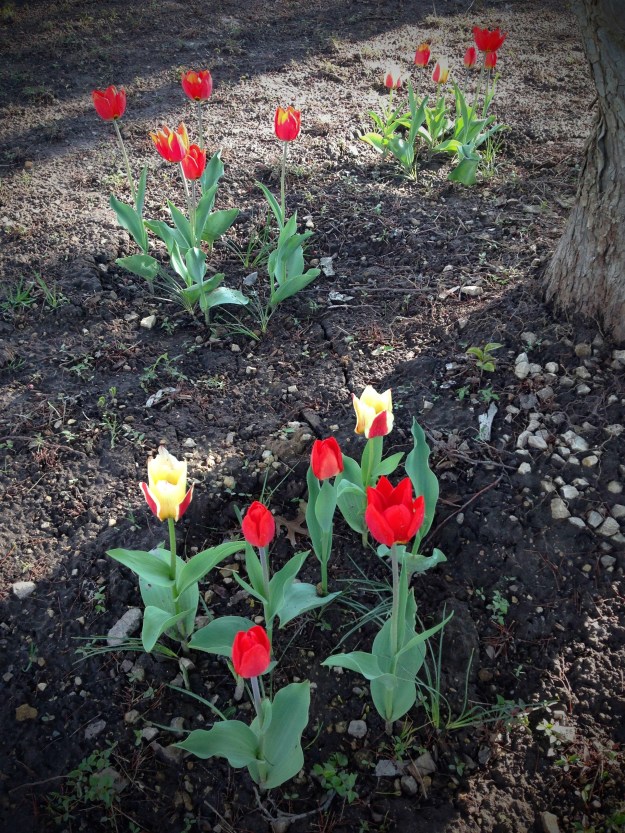
The verdict is in: the bulbs from Holland survived their first Minnesota winter! In the front yard, a few crocus leaves and blooms popped up, and the tulips seem to be flourishing. The daffodils in those same spots didn’t make an appearance, so perhaps they were too deep in the layering approach. The tulips in the backyard were chomped off at the base (leaves and stems) before they had a chance to prove themselves, but the daffodils scattered amongst them have bravely soldiered on amidst the destruction. In any case, I’ve deemed the effort a success. We’ll mulch around the plants and seed the nearby lawn later this spring, and in time it will look much less like a barren corner bursting with tulips, and much more like intentional landscaping with a pretty spring flower feature. I’m excited to see how they fill in each year. Now that they are more or less established, I can plant around them and see where it goes. Some Narcissus Actaea might fit in here quite nicely.

IMG_3701.JPG

Tulips from Holland, sharing a Minnesota plot of land with crocus leaves.

A note about resilience: half a dozen scraggly lily leaves were sticking out of a rocky hillside on our property last summer. Since we were replacing the hill with a retaining wall and a shed, we dug up the lilies, pulled the rocks from the bulb clumps (!), and lined up the sad row of yellowing leaves in a makeshift garden spot next to the raised beds. We threw in a bit of compost and hoped they would survive the mid-season move. Survive they did – each clump burst forth this spring with a bold, strong presence. It will be fun to see them bloom and determine how they might brighten up other spots in our yard.

IMG_3702 (1).JPG

Bold lilies, chomped tulips, brave daffodils.

Eggs

Last spring at about this time, we got a few chicks. Our permit allows us up to five chickens, and we read that each one might lay as many as four eggs per week. We figured that 20 eggs a week would be a lot, but our permit also says that we can not sell any of these eggs. I started stocking up on egg recipes right away.

We got a brown chick (named Henny Penny, who is an ISA Brown) and a black chick (named Ruby, who is a Wyandotte). The next week we got three more, but only two of them survived. Those two are known, somewhat interchangeably, as Ariel and Cinderella (an Easter Egger and an Australorp). The fifth one, the chicken that didn’t make it much past 48 hours on our watch, was a chirpy little thing, stumbling around in bursts of tiny energy and squawking a lot. It appeared to be blind, but boy did it have spirit. We named it Ray Ray, in honor of Ray Charles but with a nod towards the fact that we’d requested only female chicks (as roosters are not welcome in our neighborhood). RIP, Ray Ray.

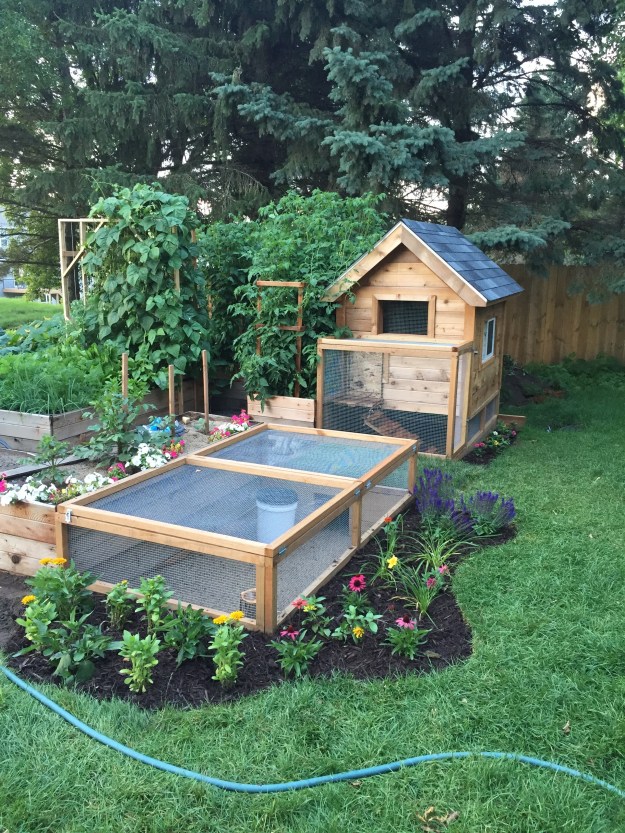
We have a spectacular chicken coop, well-constructed and fully insulated. It’s built along one end of our raised bed garden, with a screened-in run and a roost that is easily accessed for egg gathering. I should dedicate an entire post to how fantastic that whole structure is, actually, and how impressive the concept and creation of it was last spring, but let’s stay focused on eggs for the time being.

Chicken Coop

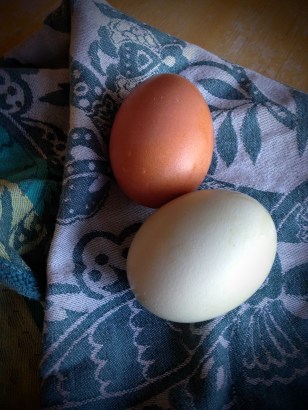
Egg production was sporadic, all summer and fall. For a long time, it seemed that only one chicken was laying eggs – Henny Penny is the biggest and bossiest of the crew (pecking order is real) and I once opened the egg collection door while she was on the roost. That’s when I learned that a seated chicken, from the back, appears to be a pyramid of tail feathers. Her eggs look very much like the brown ones you can get at the grocery store. At some point last summer, there also started to be eggs that were slightly less brown, and a little freckled. Our Easter Egger was supposed to lay blue and green eggs (appropriately IMG_3530named), but didn’t do so until well into the winter. Our chickens took so long to ramp up that we didn’t really notice a decline in production during the colder and shorter days of winter.
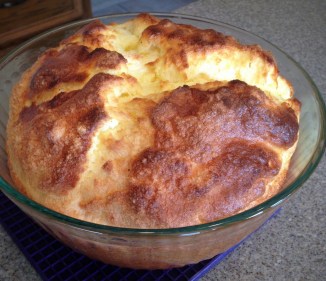
Production has increased in the last week or two, which is a nice reminder that our food really is tied to the earth and the seasons. It feels vaguely springy to me, and so it must to our chickens, as well. We are gathering about four eggs every day, of various sizes and colors. And so, a year into having chickens, I have turned to the egg recipes that I gathered in anticipation of this moment. The frittata was really easy, the souffle a bit more complex, and both were delicious.

***

Ham and Peas Frittata – adjusted from a Real Simple recipe

Ingredients:

  • 3 tablespoons extra-virgin olive oil
  • 1 cup frozen peas
  • 1/4 pound thinly sliced ham, cut into 1-inch pieces
  • 8 large eggs
  • 3 tablespoons milk
  • 1/4 cup grated Parmesan
  • 1/4 teaspoon black pepper

Directions:

Heat oven to 350° F. Heat 1 tablespoon of the oil in an ovenproof nonstick skillet over medium heat. Add the peas and ham and cook, stirring, for 3 minutes.

Meanwhile, in a medium bowl, whisk together the eggs, milk, Parmesan, and pepper. Pour into the skillet and stir.

Bake until browned around the edges and puffed (a knife should come out clean), 15 to 20 minutes. Cut the frittata into triangles and serve with salad.

***

Cheese Souffle – adjusted slightly from Mark Bittman’s How to Cook Everything

IMG_3533

Ingredients:

  • 4 Tbsp butter, plus 1 tsp
  • 1/4 cup flour
  • 1 1/2 cup milk, warmed until hot to the touch
  • 6 eggs, separated
  • salt and pepper to taste
  • 1/2 tsp dry mustard
  • 1 cup finely shredded cheddar

Directions:

Heat the oven to 400° F. Grease a deep 2-quart baking dish with the teaspoon of butter. Warm the milk, separate the eggs, and grate the cheese. Once you start this recipe, things move quickly and you’ll need to be ready.

Place a medium pan over medium heat and add the remaining butter. When it foams, add the flour and turn the heat to medium-low. Cook, stirring, until the mixture darkens a bit, about 3 minutes. Whisk in the milk a little at a time to avoid lumps, then cook until the mixture is thick, just a minute or two longer.

Turn off the heat and stir in the egg yolks, salt, pepper, mustard, and cheese. Beat the egg whites with a pinch of salt, just until they hold soft peaks. Stir a coup of spoonfuls of the beaten whites into the batter, then very gently – and not overly thoroughly – fold in the remaining whites, using a rubber spatula. Be as gentle as possible.

Turn the batter into the prepared dish and bake until the souffle has risen and is browned on top, about 30-40 minutes. Use a thin skewer or knife to check the interior; if it still wet, bake another 5 minutes. If it is just moist, the souffle is done. Serve immediately.

***

Photo credits: mine!

Houseplants

I never knew my grandfather, but he was an artist and a gardener, with a great love for plants of all kinds and a particular appreciation for the amaryllis. He knew to let the bulbs go dormant each summer so that blooms could be forced in the winter, and he passed this knowledge down to his daughter-in-law, my mother. Growing up, we always had amaryllis, and I thought of them as an inheritance of sorts from Grandpa Seaverns. We also had leafy and colorful begonias, cyclamen, geranium, and African violets. Our Christmas cactus lived on a bathroom window sill designed for that very purpose and bloomed almost constantly.

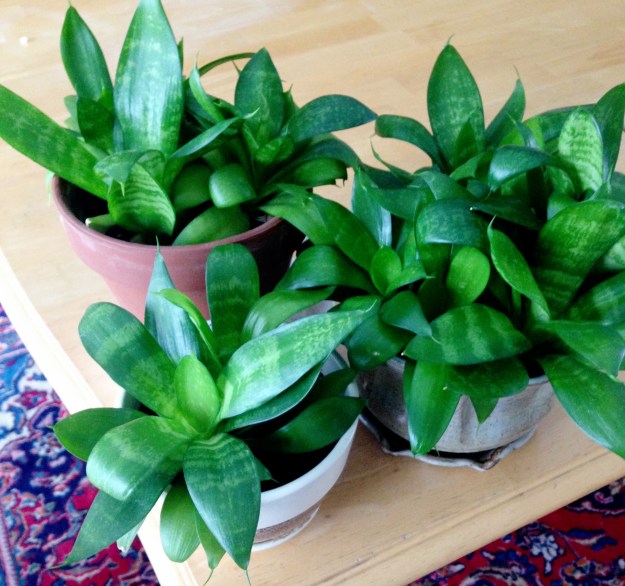
When I lived in a dorm room 15 years ago, my mother mailed me a shoebox of bromeliad wrapped in wet paper towels and a clipping of a philodendron, with a note that they’d both be easy to keep alive. She was right – I provide them with a bit of daylight and I water them when they droop, and both are still in my care, along with their various progeny. The bromeliads can’t be stopped, actually – their rich green leaves grow and curl, while baby bromeliads emerge from the shade below. They’ve never flowered in my care but I learned recently that with a bit of hocus pocus, each of those tiny new plants could be persuaded to bloom – just once. The philodendron is leggy and leafy, which I’ve always liked just fine, but apparently if I clipped those trailing vines once in a while, they would grow into a nice cluster of leaves in the pot. Over the years, additional plants have come into my life, but I’m not terribly attentive, and most of them aren’t very happy.

IMG_3366

The original bromeliads and their flock.

In October, we visited my aunt in Montreal. Her houseplants are so successful that they compete for space with the furniture. Her flowering azalea is nearly three feet across and was brilliant with blooms on the kitchen table, though it was already snowing outside. Vases and jars of philodendron provide bursts of green in the bathroom and on window sills. I came home determined to assess (and revive) my own houseplant situation.

Most problems can be solved with a spreadsheet, so I started there. I listed all the plants in my care, looked up their preferences, and got everything documented. I didn’t realize that so many houseplants prefer to be root-bound! I flipped through my mother’s houseplant book (which I’ve had on a shelf for years), threw out two of the ugliest spider plants, and put a handful of philodendron clippings into a tall vase full of water. Then I took myself to Gertens and purchased an enormous amaryllis bulb, a Christmas cactus, a few flower pots, and some potting soil. Red and white amaryllis are relatively common, but the apple blossom variety (a favorite in our family) is harder to find, and Gertens had them on hand.

IMG_3365

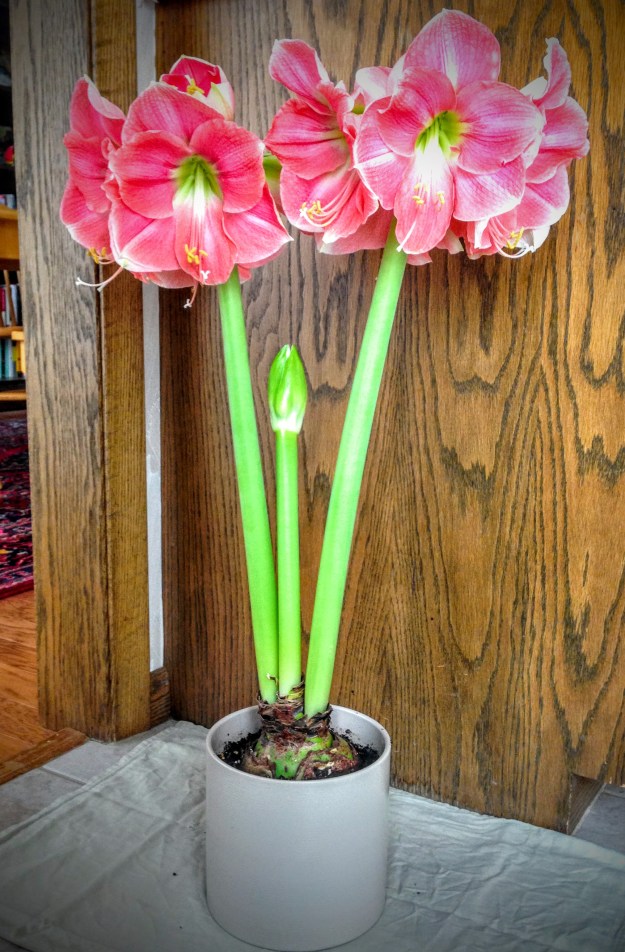
The apple-blossom amaryllis, in its full glory.

The bulb I pulled out of a barrel in October has burst forth with the most incredible floral display I have ever seen. This amaryllis has twelve blooms at once, with another flower stalk maturing, and I hope to maintain tradition by persuading it into a similar show of color next year. In contrast, all the buds on the Christmas cactus have dried up. I’ve watered it steadily and provided it with sunshine, but I think it lacks humidity. Picturing the Christmas cactus of my childhood, I moved mine into the windowless bathroom this morning while I took a shower, and back into the sunshine this afternoon. Perhaps with some dedicated attention, it can be nursed back to health.

Photo credits, mine.

Getting Started

Nearly ten years ago, I had a book review blog. It was inspired by the particular boredom that comes from sitting at a desk, day after day, without having enough to do. My job was to answer the phone, sort the mail, and greet visitors, which meant that I was largely unoccupied but frequently interrupted. The philosophy in that time and place was that book and magazine consumption was of a personal nature, but staring at a screen was a professional activity. I was not permitted to read, but computer use was encouraged.

To fill the time at my desk, I began researching books and authors, determining what to read next and writing about whichever book I had just finished. Finding myself between books – and without a review to write – made for dreadfully slow afternoons, so I was reading prolifically during my breaks and in the evenings. A few months into this uniquely personal survival strategy, the collection of reviews served as the writing portfolio that helped me land my first marketing and communications position. When I changed jobs, I stopped maintaining the blog.

In 2009, my sister and I started a blog that stayed active for two years. We each lived alone, and we were cooking and traveling and spending time with friends, writing about the stuff that seemed interesting and going through the somewhat tedious process of digital photography six years ago (downloads and uploads, chargers and cords). It was a fun collaborative effort, and I still have friends and family ask about it, but continuing to post ended up feeling like a chore as our lives got busier and we had competing priorities. All 109 posts remain accessible.

9655269808_c1479d9e61

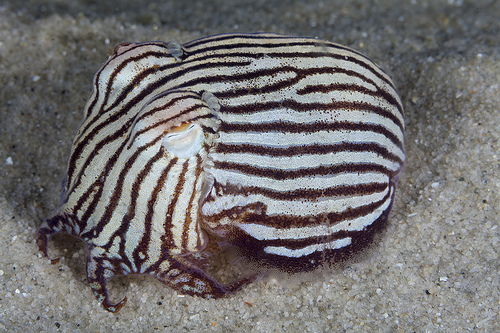
So, here I am, at the start of a new blogging adventure. Coming up with a name for the project slowed me down considerably, but I’m happy with where I landed – and why not? The pajama squid is a peculiar creature – not a squid at all, actually – and so begins the metaphor, I think. This won’t strictly be a food blog or a book review blog, nor will it be a travel blog or a lifestyle blog. This will be a place for my observations and recommendations, a writing outlet with a purpose. I’m excited to get started!

Photo credit: Pajama Squid by pacificklaus (CC BY-NC)