Author Archives: sarlinhilt

Life

It’s been a while. A year or more, I think. I’ve started a few posts – on topics as varying as what I’ve cooked lately, how I’m feeling about loss, the podcasts that most interest me, and the wonders of watching your baby in their first incredible year of existence. Nothing felt quite right for publishing, though the readership of these words is primarily a small group of family and friends.

Perhaps the issue is simply this: there’s too much to say. Too much to write. Too much on my mind. My father passed away last spring, and the loss is one that is hard to put into words. My baby was born 14 months ago, and the miracle of her life is perhaps equally difficult to articulate. I recently started writing down, once a day, the meals I’ve eaten and the moments I’ve appreciated, just to get some thoughts on paper. It’s as though my creative gears had frozen up a little, and having a reason to write something, small and insignificant, loosened things up slightly. The days are longer, too. And the magnolia we planted in our front yard last year is in bud. There’s much to celebrate.
LND_1FDD281B-F3E5-4D22-9BDE-61FF39E5919F

Here are a few things worth sharing:

This particular episode of the Better Off podcast, a surprisingly relatable personal finance resource that I generally enjoy and find to be informative. In this case, a young man calls in looking for an opinion about his potential plan to buy his recently deceased grandmother’s house from his mother, so that his brother can continue to live there. While he hikes the Pacific Crest Trail. As his story gets increasingly complicated, the host, Jill Schlesinger, simply says, “You know why I don’t like this idea? Because it doesn’t solve anyone’s problems.” Or something to that effect. It made me laugh out loud, because sometimes a person facing a decision just needs an honest assessment of their situation.

This amazing essay about modern arctic exploration. Apparently, the author, David Grann, has quite a cult following – and now I can see why. If you can cobble together two hours or so for a truly outstanding read about courage and obsession and family and history, regardless of your previous interest (or lack thereof) in icy adventures, make a point of reading this article in The New Yorker. I’m sure the print edition from February 12 & 19 is floating around in the world, but if you don’t have a copy handy, the online version is visually pleasing, with lots of well placed photos and maps.

This intriguing and accessible book about the history of flavors in American cooking. From the surprisingly exotic origins of black pepper to the enterprising immigrant tale of Sriracha, there’s much to consider from chapter to chapter. I wasn’t really in the mood for a crime solving plot or a romantic entanglement of any kind, and this was a nice way to enjoy a book without becoming emotionally engaged with a novel.

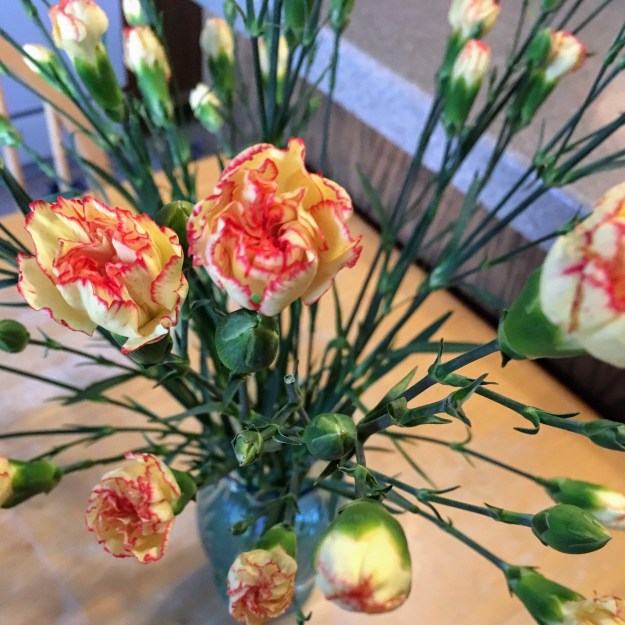
And finally, a single inexpensive handful of carnations from Trader Joe’s (see above), because a delightful photo essay in Better Homes & Gardens a few years ago alerted me to the simple beauty in loosely bundling a few dollars worth of carnations (which is a surprising lot of flowers) in a rubber band towards the base of the stems, and sliding them into a vase. The miniature ones edged in a contrasting shade are ideal, and are currently brightening our kitchen.

Photo credit: mine.
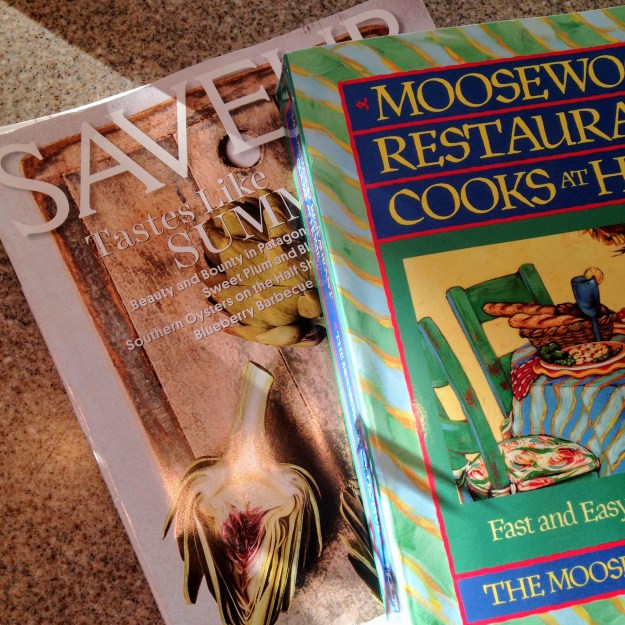
Artichokes

Artichokes are so dramatic, in all their spiky mystery. Last summer, Saveur magazine went so far as to feature them on the cover, split in half so you could see their inner workings. There are, of course, the jarred and marinated artichoke hearts that surface in pasta salads and various chicken dishes, but that’s not what I’m referencing here. Some recipes call for frozen artichokes, which I have never found, but generally replace with canned artichokes. These flavors are familiar, but I believe a real artichoke experience can only be found by eating one whole, leaf by leaf, as a sort of vegetable adventure.

img_4868

As a kid, we would occasionally have artichokes for dinner – in my memory, they would emerge from a steaming pan, sprinkled with minced garlic. We would pull off the leaves, capturing the delicious meat of each one by scraping with our teeth, and tossing the inedible parts into a central discard bowl. When you got to the center, and navigated around the prickly choke itself, you were rewarded with the heart – a dense chunk of deep but subtle flavoring; the prize inside the vegetable. There was a garlicky mayonnaise to dip everything into, and a real sense of accomplishment to be gained.

As a grown up, I’ve tried a few times to recreate this experience. I’ve known how to prep them – turned on the side, it’s easy to trim 1/4 inch off the artichoke stem and about the same off the top. Kitchen shears are handy for clipping the barbs off the remaining leaves, and with that, they’re ready to cook. I tried steaming them, stem down, and it took close to 90 minutes. I tried steaming them stem up, which was faster, but didn’t allow for any seasonings to nestle in between the leaves as I remembered. I’ve also looked up aioli recipes, and they tend to begin at the raw egg stage, where I want them to begin at the mayonnaise stage. I’ve felt each of these times that I was not quite achieving the goal.

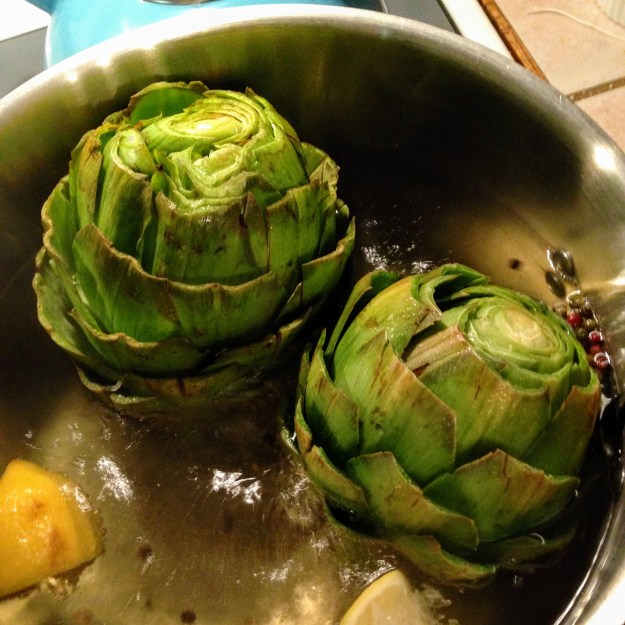
Last weekend, with the assistance of the Moosewood cookbook I’ve had for more than 15 years, everything came together. To my surprise, it includes both “Easiest Artichokes” and “Aioli” recipes – and the suggestion that they be paired. They recommend settling the prepped artichokes, stem down, in about 4 inches of boiling water – and adding whatever seasonings you like to the water itself or sprinkled over the top. In this arrangement, a significant amount of artichoke was above water, but almost immediately, a delightfully artichoke-y steam began sneaking out from the edges of the lid. Half an hour later, they were ready!

img_4861

Eating an artichoke necessarily slows down a meal and makes it an event. As you work your way through the tough outer leaves, dipping each into the aioli and only eating the edible parts, each bite gets more tender and delicious. When the leaves give way to the poky, feathery, choke at the center, try to pull it back from the edges gently. With a lot of patience and the steady pressure of a butter knife, it is possible to extract and discard the entire choke without cutting into the heart at all – think of this as a culinary challenge. The same caution should be taken when trimming away any tough bits on the stem end, as you want to salvage as much of the heart as is possible (to eat, obviously).

The aioli recipe began with a cup of mayonnaise, and the addition of a bit of garlic, lemon juice, and olive oil resulted in an intense and perfectly complementary dipping sauce for the artichokes. There was more than we needed for the meal, but the leftovers have improved our sandwiches all week.

Whole artichokes for dinner are delicious, and surprisingly easy to make. California artichokes (which you’ll find at your grocery store, probably nestled in a small basket next to the eggplants and leeks) are at their peak from March to May. Select those that are about the size of a grapefruit, and primarily pale green in color. Here are the recipes, adapted slightly from the Moosewood Restaurant Cooks at Home:

Easiest Artichokes

  • 4 whole artichokes
  • optional, to flavor the cooking water: any combination of bay leaves, peppercorns, lemon juice, vinegar, garlic, capers, or fennel seeds
  • optional, to drizzle over the cooked artichokes: juice of 2 lemons, and 4 tsps of olive oil

Bring 4 inches of water to a rapid boil, add whatever flavorings you choose, and trim either end of each artichoke to create a flat base and a flat top. Clip the barbed leaf tips for a nice look – though they will soften when cooked.

When the water boils, ease the trimmed artichokes, stem end down, into the pot. Cover, lower the heat, and simmer for 25-40 minutes, until the bottoms of the artichokes are easily pierced with a fork and the leaves are easy to pull off.

Drain the artichokes, place them upright on a serving plate, and drizzle lemon juice and olive oil over them if you like. Serve immediately (or, chill them and serve later – they’ll last for a few days in the refrigerator if stored in a tight container).

Aioli

  • 1 cup mayonnaise
  • 3 Tbsp fresh lemon juice
  • 2 Tbsp olive oil
  • 3-4 garlic cloves, minced
  • black pepper to taste

In a small bowl, combine all ingredients. Cover and refrigerated, aioli keeps for about a week.

January Thoughts

Well, it’s been a while since I’ve had something to say on here. When I started this project, I had a plan – a schedule and a list of topics and ideas and concepts. It turns out that actually, I started this blog because I enjoy writing. And consequently, my motivation to write comes in waves, generally inspired by something in my life.

As it happens, I had a baby one month ago today. That inspired me to write, certainly, but not here, for the world to see (isn’t it odd that the internet really works that way?). We’re all doing well, if a little short on sleep, and her presence has forced me to slow down a little. I’ve been standing at a distance from much of the news and commentary that’s circulating, intentionally creating some space to read, and to think.

I recently finished The Optimist’s Daughter, by Eudora Welty, which won the Pulitzer Prize for Fiction in 1972. It’s a tale of family and loss and reflection, and a quote from the final passage has stayed with me. “The past is… impervious, and can never be awakened. It is memory that is the somnambulist.” The loss, in this example, is viewed simply as an event that occurred. Any pain or regret that exists is tied to the memories of that loss, which we manage as best we can. This idea that the past happens and stays put, while our memories chase us, is intriguing, and perhaps empowering.

Though I hope to tackle another book soon, essays and articles are more my speed, these days. I’ve been making my way through recent editions of The New York Times Magazine, and I can confidently recommend the following selections.

Neanderthals Were People, Too New research shows they shared many behaviors that we long believed to be uniquely human. Why did science get them so wrong? (by Jon Mooallem, January 11, 2017)

‘We Are Orphans Here’ Life and death in East Jerusalem’s Palestinian refugee camp. (by Rachel Kushner, December 1, 2016)

How to Hide $400 Million When a wealthy businessman set out to divorce his wife, their fortune vanished. The quest to find it would reveal the depths of an offshore financial system bigger than the U.S. economy. (by Nicholas Confessore, November 30, 2016)

As an aside: in referencing the list of Fiction Pulitzer Prize winners for this post, it seems equally (or better!) aligned with my reading interests than does the Booker Prize list, which I wrote about previously. If you’re looking for a reading recommendation, that may be a good place to start!

Booker Prize

I had a plan, a decade or so ago, to carry around the Booker Prize lists with me and steadily make my way through the winning selections as I made choices at the library or asked for books as gifts. As it happens, the plan didn’t stick and the list (which I had carefully formatted, printed, and folded up in my wallet) got misplaced.

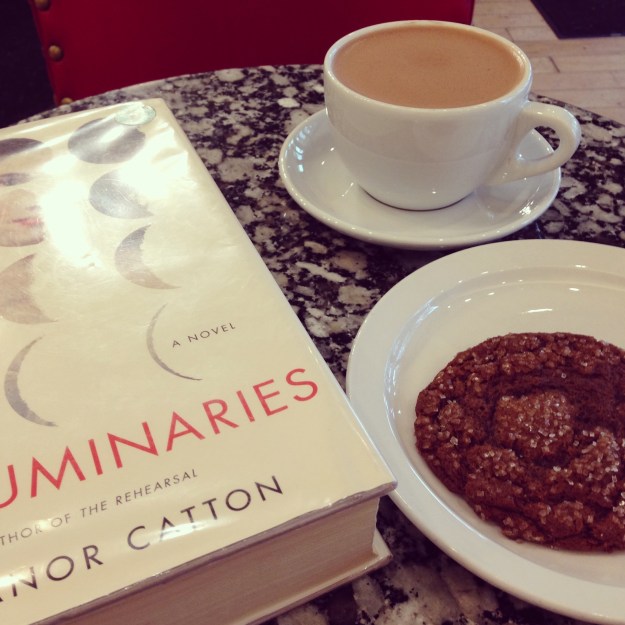
I should have stuck with the plan. This morning I finished Eleanor Catton’s extraordinary novel, The Luminaries, winner of the 2013 Man Booker Prize. It was the very best book I have read in a long time, and probably towards the top of any “favorites” list I might create. Simply put, it is clear to me that Eleanor Catton is a genius. How she imagined such a twisty tale of various perspectives is one thing – how she managed to put it all together in such a surprising and intriguing manner is quite another. Whatever you might expect of a plot set in the gold rush era of New Zealand, about 150 years ago, you’d probably be quite underestimating this tale. You might also be surprised to hear that Ms. Catton, aforementioned genius, was born in 1985 – she is the youngest author ever to win the Booker. In other literature award record breaking news, The Luminaries is the longest book ever to win the Booker. At 832 pages, this is a book that takes a bit of dedication.

img_4198

Though I haven’t exactly made my way through the lists, I see that a few of my favorites either won or were shortlisted. Notably, Simon Mawer’s The Glass Room (shortlisted in 2009), Zadie Smith’s On Beauty (shortlisted in 2005), David Mitchell’s Cloud Atlas (shortlisted in 2004), Zoe Heller’s Notes on a Scandal (shortlisted in 2003), Margaret Atwood’s The Blind Assassin (winner in 2000), Arundhati Roy’s The God of Small Things (winner in 1997), and Rohinton Mistry’s A Fine Balance (shortlisted in 1996), are all books that I would heartily recommend.

The 2017 lists won’t be released until next summer, so we all have a bit of time to work through the backlog of winners and shortlisted selections. Happy reading!

Fruit Cobbler

2011-08-09 20.25.35_Chicago_Illinois_US

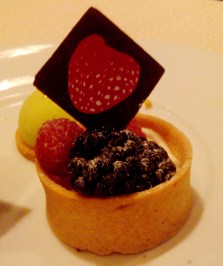
Cobbler isn’t pretty, but this bakery dessert tasted good and looks nice.

Fruit desserts are my favorite sweet option. I like the tiny jewel-like things that fancy bakeries always have on display, but those are beyond my repertoire. Cobblers are more my speed. My mom made a blueberry peach cobbler when I was growing up, usually in the winter, I think, because I remember that she used frozen blueberries and canned peaches. A note about blueberries: frozen or fresh, she always used the low-bush ones from Maine (for muffins, and pancakes, and on cereal, too) not the giant high-bush ones that are easily found in the grocery store each summer. It isn’t just a size difference. Have you ever compared an apricot with a peach? The flavor and texture and general soul differs. The same can be said for blueberry varieties. The little ones are sold frozen in the Midwest, if you do your research or manage to stumble upon them. I also suspect they grow in Minnesota and Wisconsin, but I don’t have a direct source for such delicacies.

In any case, I tried following the cobbler recipe a few times in my early years of cooking. I would go out of my way to obtain peaches and blueberries (canned and frozen, respectively), opting for a different recipe entirely if I didn’t have those two types of fruit on hand. Once I forgot to drain the peaches, which made the whole thing a bit more like soup than cobbler, though it didn’t harm the flavor. I’ve tried doubling the crust, because it is delicious – but then it comes out of the oven baked unevenly, with big spoonfuls of raw batter sitting in the boiling fruit. With patience and more attempts (or using a different recipe entirely), I could probably get the temperature and timing right to make the double batter version work, but in the meantime I’ve gone back to the original ratio.

Where I have successfully improvised with this recipe is through the somewhat recent realization that this is really a fruit cobbler recipe, and any 3 cups of fruit will do (though a combination of berries and stone fruit usually turns out best). Frozen, canned (remember to drain the fruit, in this case), or fresh is fine. This is ideal in summer, when you’re awash in berries you can’t eat fast enough – or in winter, when a fruit dessert is just the thing to boost your spirits. I have a “leftover strawberries and blackberries that won’t otherwise get eaten, topped off with a nectarine to make 3 cups” cobbler in the oven right now, and it smells incredible.

Over the weekend, I visited my sister in Seattle and she made an incredible apple-rhubarb cobbler, entirely using fruit freshly picked from her backyard. We discussed our mutual preference for fruit-on-the-bottom cobbler, as we’ve discovered that some people actually make fruit-on-top cobbler. Hers was delicious, but I forgot to get the recipe (which I think was from her King Arthur Flour Baking cookbook), and so I’m making my old standard this evening. Here it is, in case you’re inclined to give it a shot:

Blueberry Peach Cobbler 

  • 1 Tbsp cornstarch
  • 1/4 cup brown sugar
  • 1/2 cup cold water
  • 2 cups peaches, cut into bite-sized chunks
  • 1 cup blueberries
  • 1 Tbsp butter
  • 1 Tbsp lemon juice
  • 1/2 cup flour
  • 1/4 cup sugar
  • 3/4 tsp baking powder
  • 1/4 tsp salt
  • 1/4 cup milk
  • 2 Tbsp vegetable oil
  • 2 Tbsp sugar
  • 1/4 tsp nutmeg

Preheat the oven to 375.

Combine the cornstarch, brown sugar, and cold water in a saucepan on the stove. Heat on medium, whisking until thick. Add peaches and blueberries (or whatever 3 cups of fruit suits you), the butter, and the lemon juice. Stir together and heat until everything seems nicely mixed up and somewhat thick and bubbly and smelling nice.

Meanwhile, in a separate bowl, mix together the flour, 1/4 cup of sugar, baking powder, and salt, stirring well. Add the milk and oil and stir until smooth. In yet another small bowl, stir together the 2 Tbsp of sugar with the nutmeg.

Pour the fruit into a casserole dish, and pour the crust over the top (spread out to cover all the fruit, so that it bakes evenly). Sprinkle the sugar/nutmeg mixture around the top, and bake for 30 minutes.

Eat while warm, with or without a splash of milk (or cream!). Save some leftovers for breakfast, if you have that sort of willpower.

Lists

I haven’t written here for a while, not for lack of activity or thought, but rather because life is going in so many directions that I haven’t been particularly good about sitting still and thinking in a focused manner. And really, to effectively write something, sitting still and focusing is a good starting point.

I used to have a regular habit of journaling, nightly, and for periods of time it felt like a necessary element of sanity. I realized a few months ago that I had gotten out of the habit, so I bought a fresh new journal and placed it next to my bed. It turns out that I haven’t written in it much, and when I have, it reads like an oddly formal update about my life, as though the pages of my journal require me to keep current notes on the events unfolding. I dimly remember a time when I used that space to clear my head in the evenings, to explore my emotions and record them, so they could stop rattling around inside me. Maybe lately I don’t have such busy thoughts. Or, more likely, they are so busy that a journal isn’t the right tool to collect them.

IMG_4007

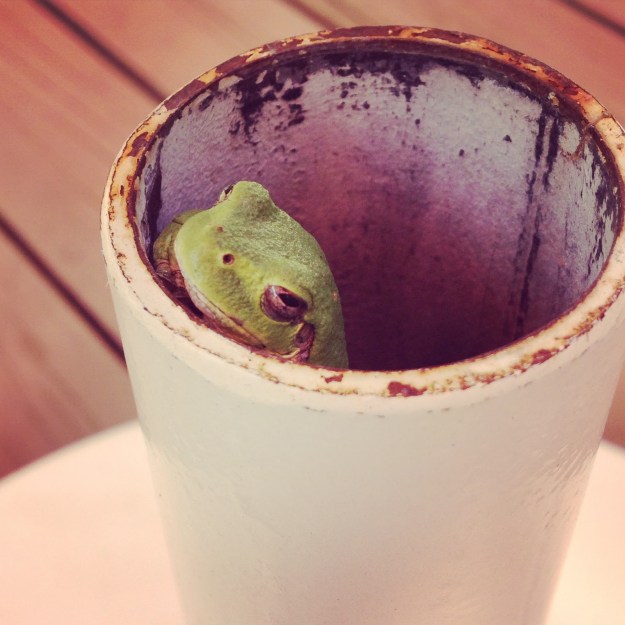
This little dude was relaxing in the umbrella stand all afternoon. Maybe he was thinking.

Which brings me to my point, really. I’m considering lists. Not in place of journaling, necessarily. But as a way to get my thoughts down on paper without trying so hard. Lists as an interim solution until my brain activity slows from a fast paced zipping about mode to a more reasonable speed where thoughts can more fully develop. I have one of those notebooks with the spirals at the top and pages divided into two columns, and I’m going to start making lists of all kinds. As a child, I had a very similar notebook. In those heady days of elementary school, I would label the columns with headings (often, “love” and “hate”) and then list names of classmates boldly down each side. I didn’t go back to revise them over time, but I had many fresh versions, and the names changed and shifted over time. Eventually I started creating a third column that was labeled “like” and most names migrated into that list. I found that notebook about 15 years ago, and perhaps there were other lists contained in those pages, but it is these definitive love/hate ones that I remember discovering.

For now, I’ll make less divisive lists. I have already started categories such as “plants to grow” or “favorite meals” or “things to do in the summer” or “places to visit” and it is going okay so far. I’ve discovered, however, that to ignore the column structure and write straight across the page is a challenge for me. My early listing instincts were to create comparisons, and it still feels appropriate to do so, or at least to use the left column for ideas and the right column for related notes. Perhaps, in the spirit of my younger self, I should really set up binaries such as “plants I love” and “plants I hate” or “places to visit” and “places to avoid” – neatly divided lists, side by side, to keep my thoughts nicely organized.

Invisibilia

Picking up where our favorite weekly radio shows got us started in years past (Splendid Table, This American Life, RadioLab), podcasts give us a chance to learn or be amused, on our time, at our convenience. I like to listen to them when I’m cooking or driving or taking a walk, and the wide range of options means that I can pick a topic or a theme that suits my mood or inclination at the time.

Invisibilia was released at the start of 2015, with six episodes that were each an hour long. This is an NPR podcast, and here’s their description of it: Invisibilia (Latin for invisible things) is about the invisible forces that control human behavior – ideas, beliefs, assumptions and emotions.

IMG_3859.JPG

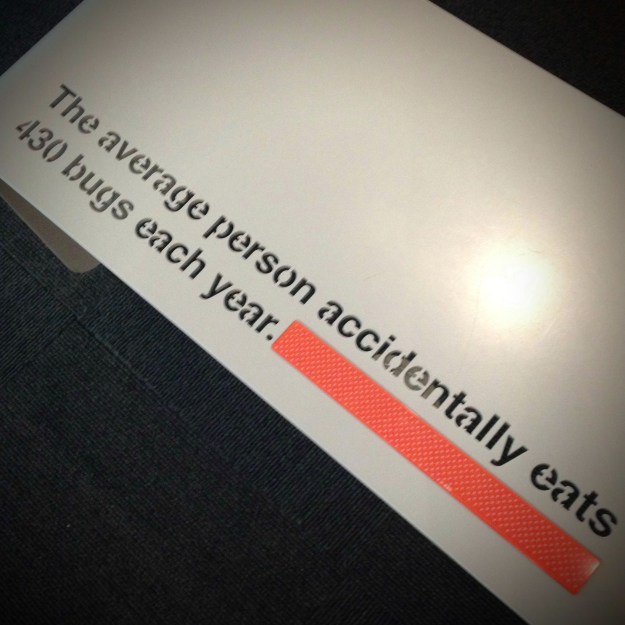
Speaking of invisible things: I spotted this astounding fact on a bench at the Perot Museum of Nature and Science last week in Dallas.

Like the very best of Radiolab segments (such as Darwinvaganza), this podcast mixes scientific research with story telling. Though all six episodes continue to be available and are worth a listen, Entanglement was one of my favorites. If you have an hour to spare and you’re interested in stretching your brain in a few directions, I very much recommend it. First, there’s a brief physics lesson, then a tale of a seemingly impossible human condition, andIMG_3869.PNG finally a visit with comedian Maria Bamford (who is touchingly hilarious and happens to be from Minnesota). True to the theme, each of the topics touches on entanglement. More than a year after I initially listened to it, the concepts and ideas that were introduced to me here continue to bounce around in my head.
A new season of Invisibilia is starting June 17, and I expect it to be thought provoking. If you listen to it, let me know. I’m sure there will be much to discuss.

A note to those of you primarily reading my posts in your inbox: the format is better if you click through to the Pajama Squid site, even if you’re on your phone or an iPad. Also, some pictures show up there that don’t come through in your email, and I’d hate for you to miss out!

Spring Blooms

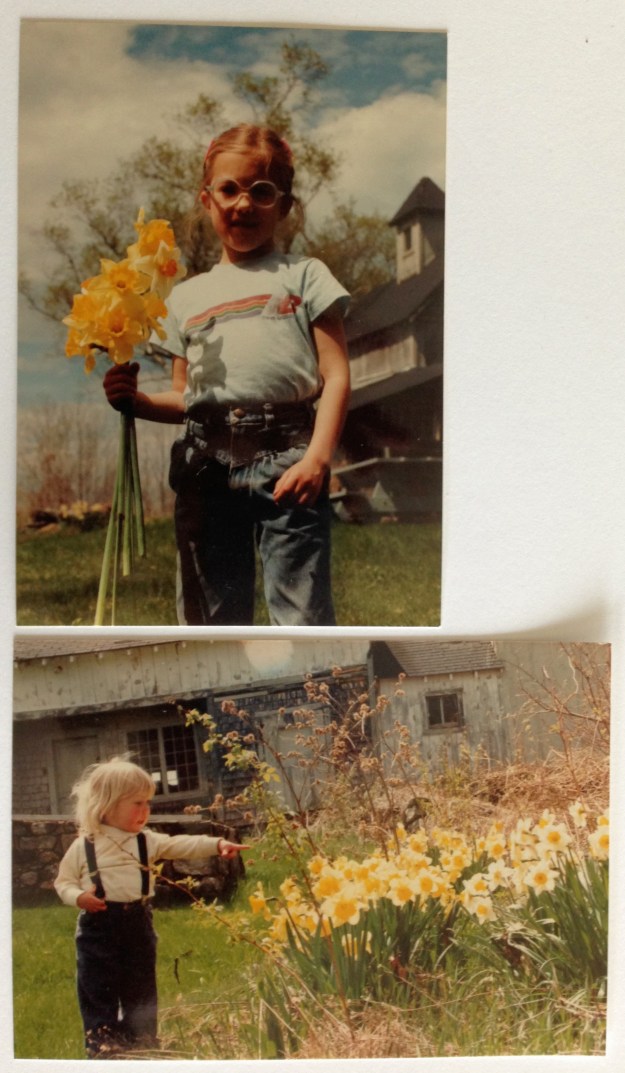
The sturdiest plants of my childhood grew from bulbs. Those reliable little balls of energy would poke leaves and stems up through the dirt every spring – daffodils, especially, multiplying each year to create enormous sprawls of color. We grew up surrounded by my grandfather’s well-established gardens, making bouquets and taking the splendor for granted. As I got a bit older I loved to dig up the bulbs on a fall afternoon, separate them to encourage growth, and reshape the drifts. I’m partial to single varieties, doubles being a bit too showy for my liking, and my favorite is the delicate Narcissus Actaea, known as the Original Poet’s Daffodil. Each slender stem produces a simple but elegant bloom that is startlingly white with a yellow trumpet edged in red.

IMG_3706

Me, holding daffodils. My sister, pointing at some. 1988.

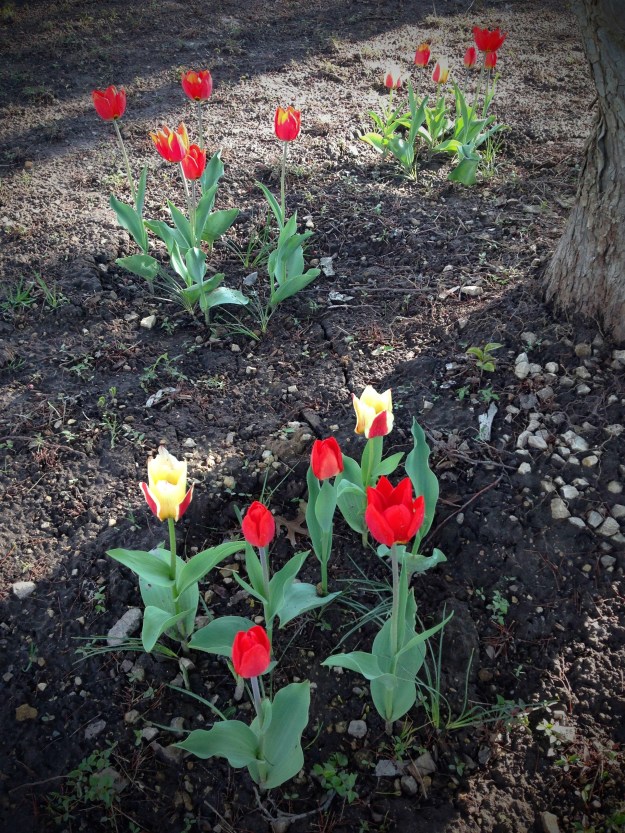
This is our second spring in this house, and the landscaping choices of the previous owners relied heavily on expanses of black plastic covered in 2-inch rock. We’re gradually undoing that approach, and a great effort was made last summer to clear the area around a crabapple tree in our front yard and get down to dirt. In the fall, much later in the year than was practical, we ordered some bulbs from Holland (truly – the box was stamped by customs!). We dug three holes near the recently liberated trunk of the crabapple tree and applied a layering approach that I found on the internet. The concept, which would also work in a container, was to build a sort of lasagna of bulbs and soil and compost, allowing for various types of flowers to exist in one little plot. Daffodils went in first, then the soil and compost, the tulips, more soil and compost, and then the crocus bulbs (and more soil). I planted the remaining daffodils and tulips in the backyard, my frozen fingers reminding me that the third week of November was a bit late for such a project. The chill in the air and the soil made me wonder if any spring blooms would even emerge.

The verdict is in: the bulbs from Holland survived their first Minnesota winter! In the front yard, a few crocus leaves and blooms popped up, and the tulips seem to be flourishing. The daffodils in those same spots didn’t make an appearance, so perhaps they were too deep in the layering approach. The tulips in the backyard were chomped off at the base (leaves and stems) before they had a chance to prove themselves, but the daffodils scattered amongst them have bravely soldiered on amidst the destruction. In any case, I’ve deemed the effort a success. We’ll mulch around the plants and seed the nearby lawn later this spring, and in time it will look much less like a barren corner bursting with tulips, and much more like intentional landscaping with a pretty spring flower feature. I’m excited to see how they fill in each year. Now that they are more or less established, I can plant around them and see where it goes. Some Narcissus Actaea might fit in here quite nicely.

IMG_3701.JPG

Tulips from Holland, sharing a Minnesota plot of land with crocus leaves.

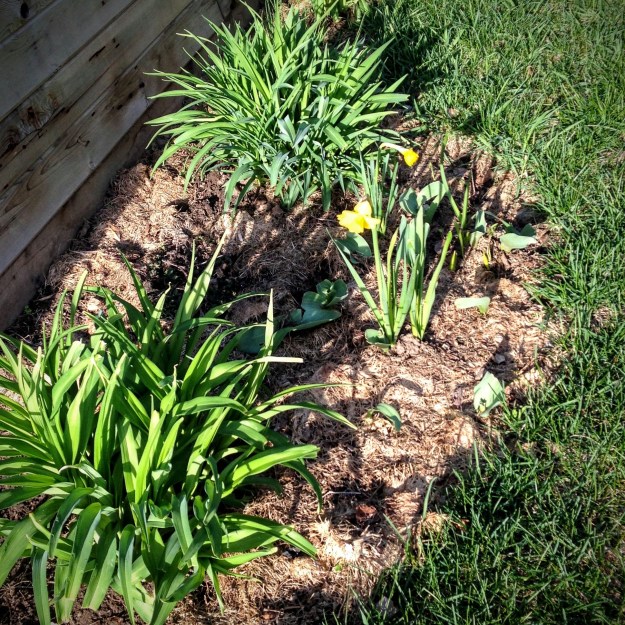
A note about resilience: half a dozen scraggly lily leaves were sticking out of a rocky hillside on our property last summer. Since we were replacing the hill with a retaining wall and a shed, we dug up the lilies, pulled the rocks from the bulb clumps (!), and lined up the sad row of yellowing leaves in a makeshift garden spot next to the raised beds. We threw in a bit of compost and hoped they would survive the mid-season move. Survive they did – each clump burst forth this spring with a bold, strong presence. It will be fun to see them bloom and determine how they might brighten up other spots in our yard.

IMG_3702 (1).JPG

Bold lilies, chomped tulips, brave daffodils.

Reading.

As I collect my notes about spring flowers (daffodils are abloom!) and plan a proper post, here is another installment regarding my latest adventures in reading.

Forty Rooms, by Olga Grushin

I wasn’t so sure about this book when I got started, but that happens sometimes. However, as the dreams and tales of the main character took shape, I realized how charming the approach was, to weave a life across the forty rooms it exists in over time. Born and raised in Moscow, the narrator moves to America for college and her life unfolds from there. Though much of the story takes place in the East Coast suburbs, there is something quite Russian about the novel and its layers of love and despair.

Case Histories, by Kate Atkinson

I love me some Kate Atkinson, and this is the first in her mystery series. I stumbled upon this wonderful book a few years ago, and then lost track of the author. When Life After Life became so famous, I sorted out that this was the same genius I had accidentally discovered earlier, and now I am very slowly permitting myself to read her books as a treat (though it appears that when I run out I can watch her show!). Her characters are complicated and interesting, and she delivers a twisty topsy mystery with a clever literary touch.

It’s What I Do: A Photographer’s Life of Love and War, by Lynsey Addario

It seems that the world is a beautiful and often troubled place, with more similarities between people than differences. The life that Lynsey Addario has chosen, photographing communities and conflicts in distant corners of the world, is courageous and eye-opening. Creating relationships in the most unlikely of places, she has followed her heart and her instincts and her photojournalism assignments to the most dangerous places at the most dangerous times. This is an astounding tale with a message that settled deep within me.

Eleanor & Park, by Rainbow Rowell

If you were ever a teenager, you can probably connect with this story. From my advanced age of 33, it seems like a much too complex and violent and sexual tale for actual teenagers to read, but apparently that is the intended audience. Much can be said that is trite or foolish about those years when life and love seem so impossible, but this author wrote a surprisingly lovely story about some truly real and troubled teenagers, and I couldn’t recommend it more. Here’s a proper review of it that is lovely in its own right.

Salt to the Sea, by Ruta Sepetys

This is a beautiful and thought provoking piece of historical fiction. It’s 1945 and thousands of people are headed west from Latvia, Lithuania, East Prussia, and Poland, fleeing the advancing Russian forces who are gaining a reputation for violence towards civilians. Unfortunately, unless you carried the correct identification papers, arriving in German territory brought its own complications. The story moves quickly, as the narration shifts easily between four individuals with their own unique perspectives.

Ready Player One, by Ernest Cline

The future looks grim in this dystopian tale about a society that prefers to log into a world of virtual reality than face the despair around them. It’s at once a warning bell to remind us that the real world is where life happens, and a nostalgic look back at the video games and music of the 1980s. We’re following a young man who is tackling the biggest challenge yet presented in their virtual world, a sort of online riddle with real life consequences. Even though I don’t possess a deep catalog of gaming memories, I really enjoyed this cleverly imagined novel.

Eggs

Last spring at about this time, we got a few chicks. Our permit allows us up to five chickens, and we read that each one might lay as many as four eggs per week. We figured that 20 eggs a week would be a lot, but our permit also says that we can not sell any of these eggs. I started stocking up on egg recipes right away.

We got a brown chick (named Henny Penny, who is an ISA Brown) and a black chick (named Ruby, who is a Wyandotte). The next week we got three more, but only two of them survived. Those two are known, somewhat interchangeably, as Ariel and Cinderella (an Easter Egger and an Australorp). The fifth one, the chicken that didn’t make it much past 48 hours on our watch, was a chirpy little thing, stumbling around in bursts of tiny energy and squawking a lot. It appeared to be blind, but boy did it have spirit. We named it Ray Ray, in honor of Ray Charles but with a nod towards the fact that we’d requested only female chicks (as roosters are not welcome in our neighborhood). RIP, Ray Ray.

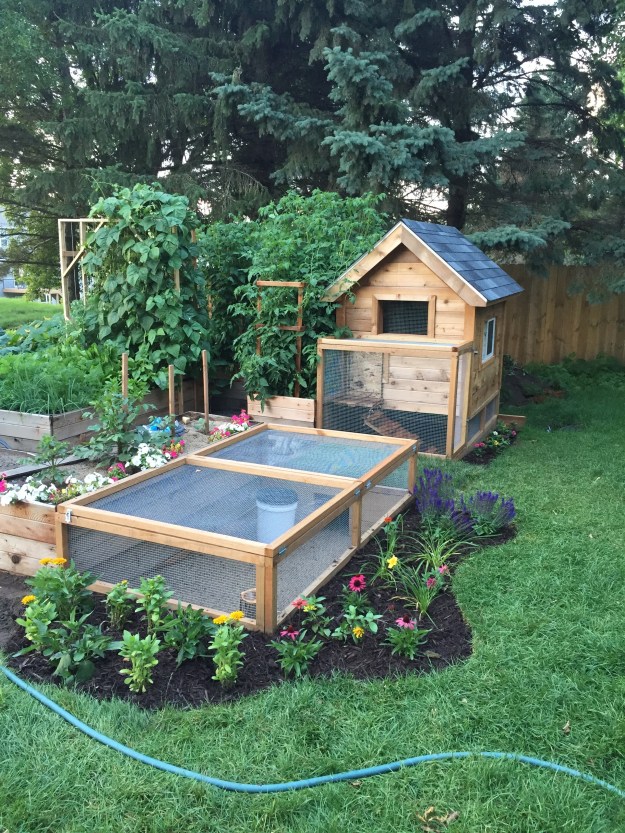
We have a spectacular chicken coop, well-constructed and fully insulated. It’s built along one end of our raised bed garden, with a screened-in run and a roost that is easily accessed for egg gathering. I should dedicate an entire post to how fantastic that whole structure is, actually, and how impressive the concept and creation of it was last spring, but let’s stay focused on eggs for the time being.

Chicken Coop

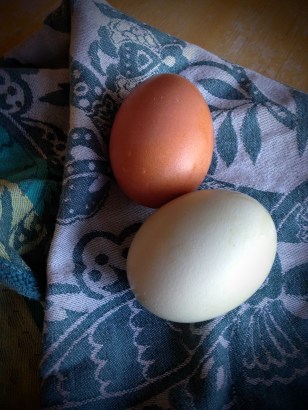
Egg production was sporadic, all summer and fall. For a long time, it seemed that only one chicken was laying eggs – Henny Penny is the biggest and bossiest of the crew (pecking order is real) and I once opened the egg collection door while she was on the roost. That’s when I learned that a seated chicken, from the back, appears to be a pyramid of tail feathers. Her eggs look very much like the brown ones you can get at the grocery store. At some point last summer, there also started to be eggs that were slightly less brown, and a little freckled. Our Easter Egger was supposed to lay blue and green eggs (appropriately IMG_3530named), but didn’t do so until well into the winter. Our chickens took so long to ramp up that we didn’t really notice a decline in production during the colder and shorter days of winter.
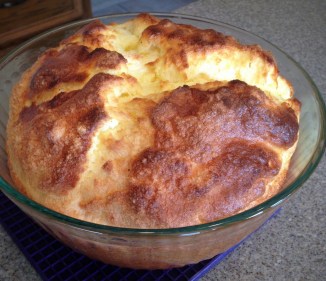
Production has increased in the last week or two, which is a nice reminder that our food really is tied to the earth and the seasons. It feels vaguely springy to me, and so it must to our chickens, as well. We are gathering about four eggs every day, of various sizes and colors. And so, a year into having chickens, I have turned to the egg recipes that I gathered in anticipation of this moment. The frittata was really easy, the souffle a bit more complex, and both were delicious.

***

Ham and Peas Frittata – adjusted from a Real Simple recipe

Ingredients:

  • 3 tablespoons extra-virgin olive oil
  • 1 cup frozen peas
  • 1/4 pound thinly sliced ham, cut into 1-inch pieces
  • 8 large eggs
  • 3 tablespoons milk
  • 1/4 cup grated Parmesan
  • 1/4 teaspoon black pepper

Directions:

Heat oven to 350° F. Heat 1 tablespoon of the oil in an ovenproof nonstick skillet over medium heat. Add the peas and ham and cook, stirring, for 3 minutes.

Meanwhile, in a medium bowl, whisk together the eggs, milk, Parmesan, and pepper. Pour into the skillet and stir.

Bake until browned around the edges and puffed (a knife should come out clean), 15 to 20 minutes. Cut the frittata into triangles and serve with salad.

***

Cheese Souffle – adjusted slightly from Mark Bittman’s How to Cook Everything

IMG_3533

Ingredients:

  • 4 Tbsp butter, plus 1 tsp
  • 1/4 cup flour
  • 1 1/2 cup milk, warmed until hot to the touch
  • 6 eggs, separated
  • salt and pepper to taste
  • 1/2 tsp dry mustard
  • 1 cup finely shredded cheddar

Directions:

Heat the oven to 400° F. Grease a deep 2-quart baking dish with the teaspoon of butter. Warm the milk, separate the eggs, and grate the cheese. Once you start this recipe, things move quickly and you’ll need to be ready.

Place a medium pan over medium heat and add the remaining butter. When it foams, add the flour and turn the heat to medium-low. Cook, stirring, until the mixture darkens a bit, about 3 minutes. Whisk in the milk a little at a time to avoid lumps, then cook until the mixture is thick, just a minute or two longer.

Turn off the heat and stir in the egg yolks, salt, pepper, mustard, and cheese. Beat the egg whites with a pinch of salt, just until they hold soft peaks. Stir a coup of spoonfuls of the beaten whites into the batter, then very gently – and not overly thoroughly – fold in the remaining whites, using a rubber spatula. Be as gentle as possible.

Turn the batter into the prepared dish and bake until the souffle has risen and is browned on top, about 30-40 minutes. Use a thin skewer or knife to check the interior; if it still wet, bake another 5 minutes. If it is just moist, the souffle is done. Serve immediately.

***

Photo credits: mine!