
Last spring at about this time, we got a few chicks. Our permit allows us up to five chickens, and we read that each one might lay as many as four eggs per week. We figured that 20 eggs a week would be a lot, but our permit also says that we can not sell any of these eggs. I started stocking up on egg recipes right away.
We got a brown chick (named Henny Penny, who is an ISA Brown) and a black chick (named Ruby, who is a Wyandotte). The next week we got three more, but only two of them survived. Those two are known, somewhat interchangeably, as Ariel and Cinderella (an Easter Egger and an Australorp). The fifth one, the chicken that didn’t make it much past 48 hours on our watch, was a chirpy little thing, stumbling around in bursts of tiny energy and squawking a lot. It appeared to be blind, but boy did it have spirit. We named it Ray Ray, in honor of Ray Charles but with a nod towards the fact that we’d requested only female chicks (as roosters are not welcome in our neighborhood). RIP, Ray Ray.
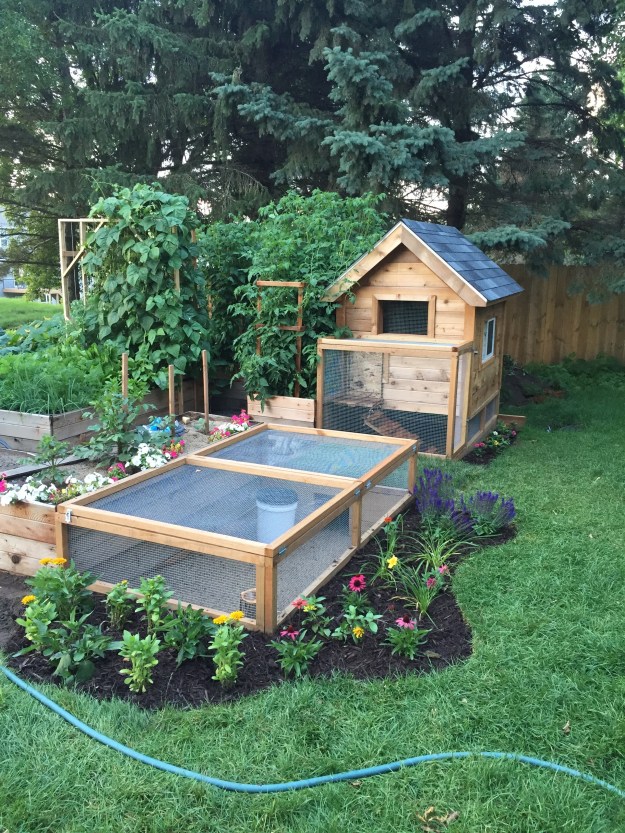
We have a spectacular chicken coop, well-constructed and fully insulated. It’s built along one end of our raised bed garden, with a screened-in run and a roost that is easily accessed for egg gathering. I should dedicate an entire post to how fantastic that whole structure is, actually, and how impressive the concept and creation of it was last spring, but let’s stay focused on eggs for the time being.
Egg production was sporadic, all summer and fall. For a long time, it seemed that only one chicken was laying eggs – Henny Penny is the biggest and bossiest of the crew (pecking order is real) and I once opened the egg collection door while she was on the roost. That’s when I learned that a seated chicken, from the back, appears to be a pyramid of tail feathers. Her eggs look very much like the brown ones you can get at the grocery store. At some point last summer, there also started to be eggs that were slightly less brown, and a little freckled. Our Easter Egger was supposed to lay blue and green eggs (appropriately 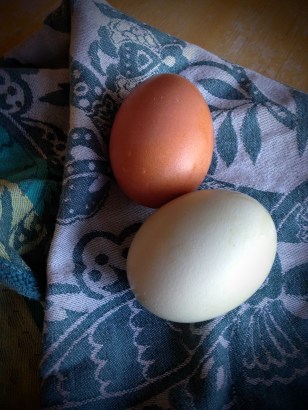 named), but didn’t do so until well into the winter. Our chickens took so long to ramp up that we didn’t really notice a decline in production during the colder and shorter days of winter.
Production has increased in the last week or two, which is a nice reminder that our food really is tied to the earth and the seasons. It feels vaguely springy to me, and so it must to our chickens, as well. We are gathering about four eggs every day, of various sizes and colors. And so, a year into having chickens, I have turned to the egg recipes that I gathered in anticipation of this moment. The frittata was really easy, the souffle a bit more complex, and both were delicious.
***
Ham and Peas Frittata – adjusted from a Real Simple recipe
Ingredients:
- 3 tablespoons extra-virgin olive oil
- 1 cup frozen peas
- 1/4 pound thinly sliced ham, cut into 1-inch pieces
- 8 large eggs
- 3 tablespoons milk
- 1/4 cup grated Parmesan
- 1/4 teaspoon black pepper
Directions:
Heat oven to 350° F. Heat 1 tablespoon of the oil in an ovenproof nonstick skillet over medium heat. Add the peas and ham and cook, stirring, for 3 minutes.
Meanwhile, in a medium bowl, whisk together the eggs, milk, Parmesan, and pepper. Pour into the skillet and stir.
Bake until browned around the edges and puffed (a knife should come out clean), 15 to 20 minutes. Cut the frittata into triangles and serve with salad.
***
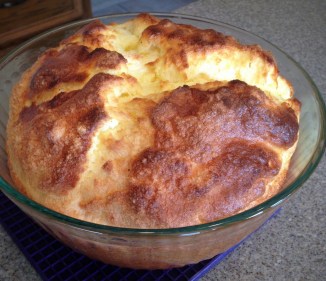
Cheese Souffle – adjusted slightly from Mark Bittman’s How to Cook Everything
Ingredients:
- 4 Tbsp butter, plus 1 tsp
- 1/4 cup flour
- 1 1/2 cup milk, warmed until hot to the touch
- 6 eggs, separated
- salt and pepper to taste
- 1/2 tsp dry mustard
- 1 cup finely shredded cheddar
Directions:
Heat the oven to 400° F. Grease a deep 2-quart baking dish with the teaspoon of butter. Warm the milk, separate the eggs, and grate the cheese. Once you start this recipe, things move quickly and you’ll need to be ready.
Place a medium pan over medium heat and add the remaining butter. When it foams, add the flour and turn the heat to medium-low. Cook, stirring, until the mixture darkens a bit, about 3 minutes. Whisk in the milk a little at a time to avoid lumps, then cook until the mixture is thick, just a minute or two longer.
Turn off the heat and stir in the egg yolks, salt, pepper, mustard, and cheese. Beat the egg whites with a pinch of salt, just until they hold soft peaks. Stir a coup of spoonfuls of the beaten whites into the batter, then very gently – and not overly thoroughly – fold in the remaining whites, using a rubber spatula. Be as gentle as possible.
Turn the batter into the prepared dish and bake until the souffle has risen and is browned on top, about 30-40 minutes. Use a thin skewer or knife to check the interior; if it still wet, bake another 5 minutes. If it is just moist, the souffle is done. Serve immediately.
***
Photo credits: mine!
 pajamasquidblog.com
Beautiful Chicken coop area! I’m impressed! ☺️
LikeLike